
Contents
Commercial impact assessment (CIA)
Commercial impact shall be checked at key stages of the governance process. Figures 1a and 1b (split due to size of image) provide all relevant stages with indication of when commercial impact is to be assessed, both qualitatively and quantitatively. Figures 1a and 1b also clarify roles and responsibilities.
DDP = Document development plan
IAR = Impact assessment report
RAD = Requirements and Advice document
TSC = Technical Standards Committee
TSG = Technical Standards Group
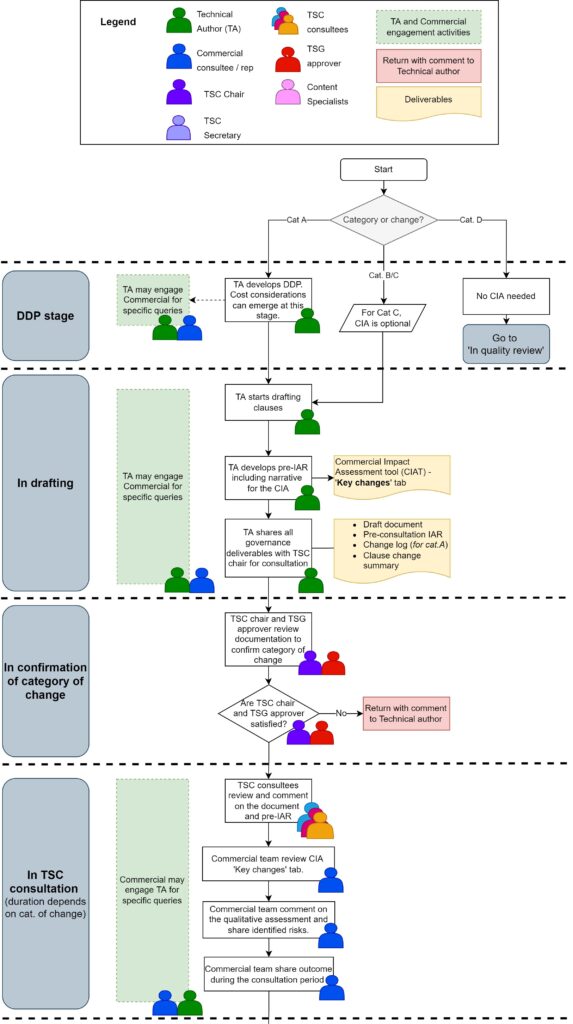
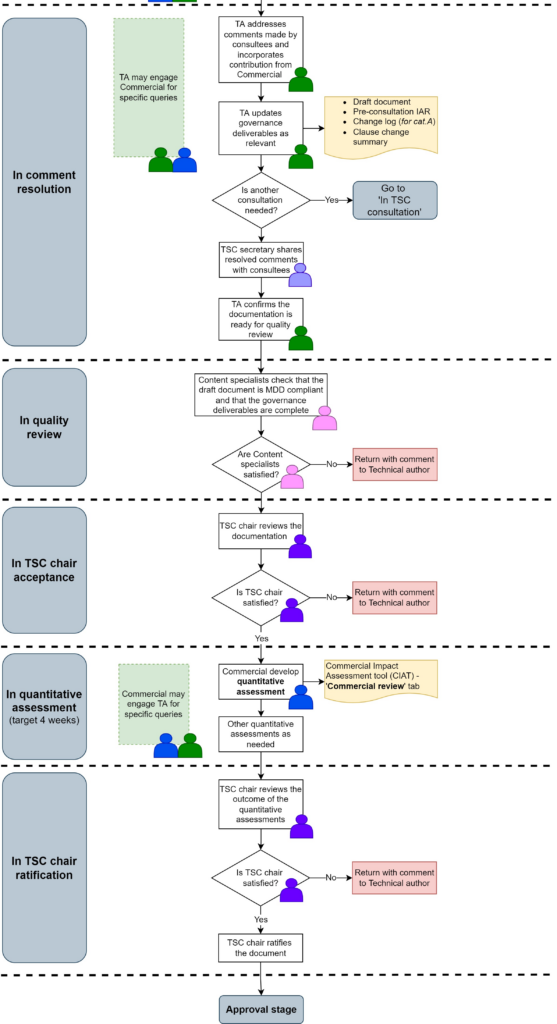
Please see MDD part 1 (Section 7 and Annex 1D) for related requirements.
Back to topCommercial impact assessment toolkit (CIAT)
A copy of the commercial impact assessment toolkit can be downloaded from here: Commercial impact assessment toolkit
The CIAT is made up of four tabs (see Figure 2):

Guidance tab
The Guidance tab clarifies the following topics:
- When the CIAT has to be used
- What Technical Authors have to do
- What Commercial team will do
- Contribution of other Directorates
- Outcomes of the assessment
A fundamental concept for the CIAT is ‘Key Change’, which is something that is different from what is done in current industry practice and which may have commercial implications. Not all modifications made to a RAD are therefore ‘Key Changes’. Technical Authors are responsible for identifying ‘Key Changes’ to help Commercial understand what has changed and quantify its impact.
Back to topKey Changes tab
The Key Changes tab shall be completed by Technical authors (see Figure 3):
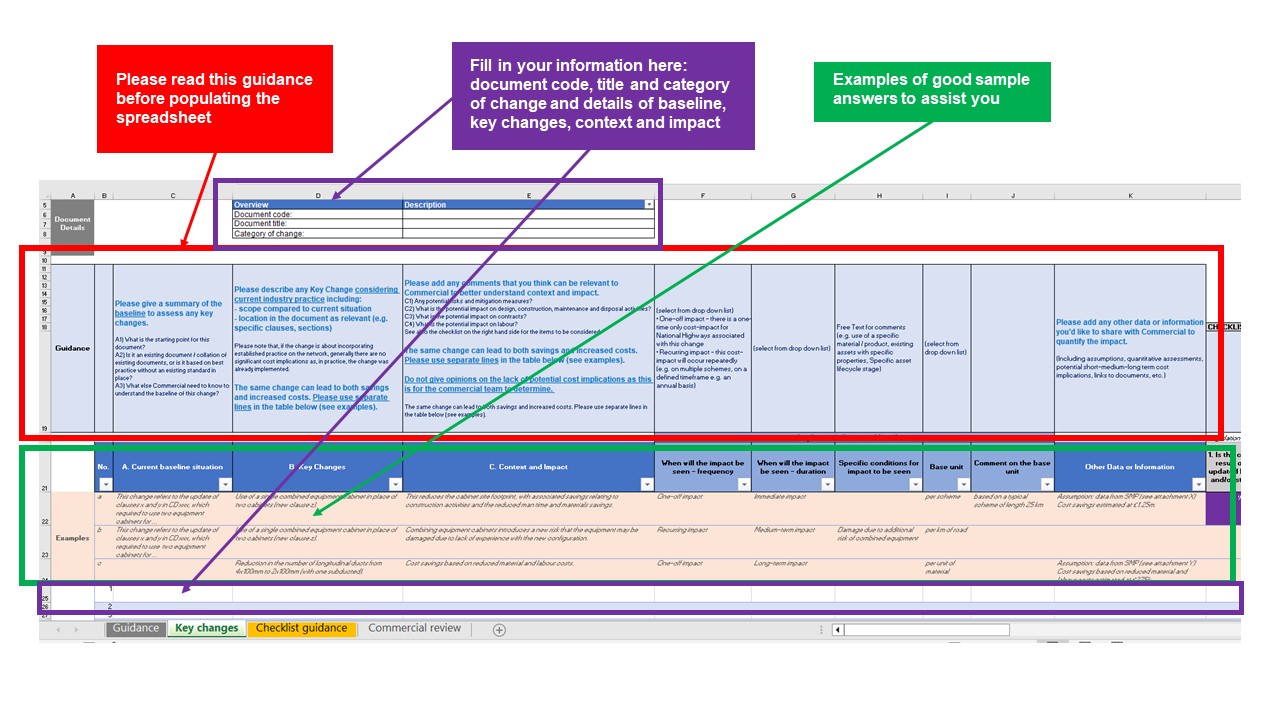
Technical authors shall provide as much information and narrative as possible in the CIAT ‘Key changes’ tab to define the changes based on their technical knowledge. Areas that shall be covered include: potential risks and mitigation measures, assumptions, data, research study.
A distinction shall be made between savings and additional costs also for the same key change and provide explanation.
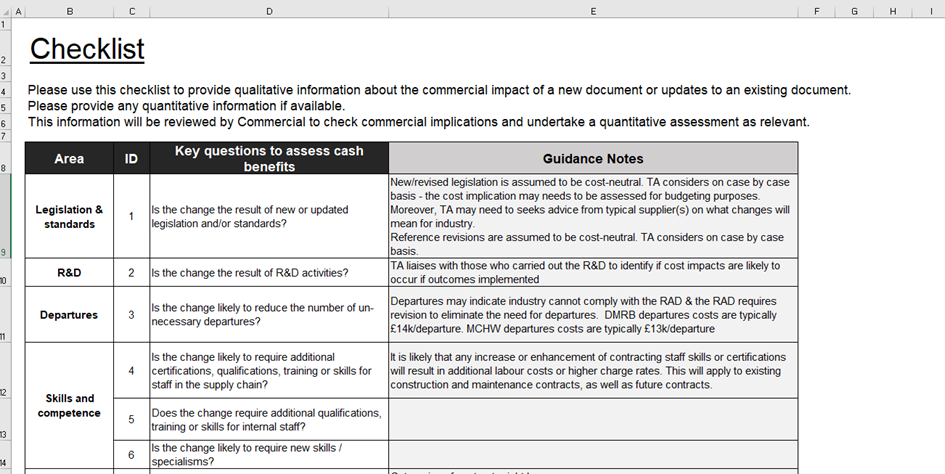
The checklist provided in the Checklist tab shall be used to assess the commercial impact of the Key changes from a qualitative point of view (see below).
Technical authors shall look at the implementation of the RAD through the eyes of those who have to implement it. They will share implementation considerations including: frequency and duration of the impact; specific conditions for the impact to be seen (e.g. use of specific material, specific asset life-cycle stage); base unit (e.g. per scheme, per km of road, per unit of material).
Evidence of this qualitative assessment shall be shared for Commercial to review.
Troubleshooting: Completing the Key changes tab – provision of quantitative information
To recap, the CIAT is used to inform the quantitative assessment. The commercial team rely on you, as technical specialists, to provide good quality information to facilitate a quantitative assessment of the commercial impacts. If adequate information is not provided this can result in a delay to the progress of your change item through the standards governance process.
The CIAT is a template for you to list the key changes made to your document and includes a checklist to identify the potential impact. There may be multiple impacts for a given change. For each of these impacts, please provide relevant, referenced, quantitative information, including:
- Relevant quantities involved on the NH network
- Relevant cost implications per base unit
This might involve engaging with industry contacts (e.g key suppliers, NH colleagues in Operations or Major Projects)to obtain this information. As technical specialists you have a unique understanding of the implications of the technical changes being made to your document.
If information cannot be obtained, then a plausible justification needs to be provided for the absence of this information. For example:
- Not OK – “This information is not available”
- OK – “No data is captured centrally, or at a project level or with key suppliers relating to the quantity of XX used on the highway network. Enquiries have been made with XX and XX to confirm the absence of this data”
Checklist tab
The Checklist tab shall be used by Technical authors to provide qualitative information about the commercial impact of a new document or updates to an existing document. This information will be reviewed by Commercial to check commercial implications and undertake a quantitative assessment as relevant.
Commercial review tab
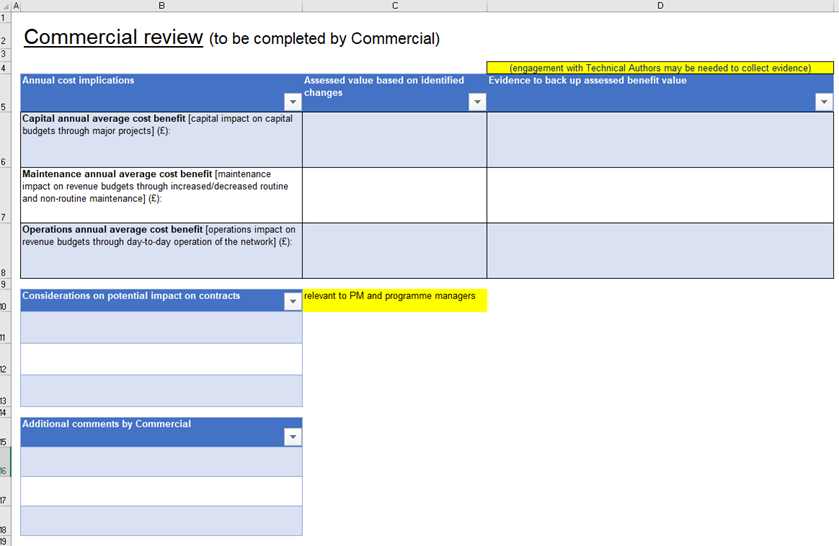
During the stage ‘In quantitative assessment’ (see Figure 1b), Commercial representatives shall complete the Commercial review tab (see Figure 5) and include the findings of their quantitative assessment. The basis of any cost estimates shall be explained, including the results of any cost assessment studies, and evidence shall be recorded so that it can be used for the SES efficiency register.
Commercial representatives shall provide considerations on potential impacts on contracts. This information is valuable for Major Projects and Operations at document implementation stage.
Further support
A training video for technical authors is available here. A PDF copy of the video slides is available here.
A training video for TSC chairs and secretaries is available here. A PDF copy of the video slides is available here.
Please see MDD part 1 – sections 7 and Annex 1D.
Back to top