What is a high-level narrative ?
- A high-level narrative is a compilation of key information to support the approval and authorisation stages of the Standards Governance Process for Category A & B changes.
What information is in a high-level narrative ?
- High-level narrative templates are provided here (DMRB link / MCHW link)
- A high-level narrative includes:
- Document information – including title, discipline, scope and related documents
- Key changes or aspects covered – typically taken from the Commercial Impact Assessment Toolkit.
- Commercial Impact – conclusion from quantitative commercial assessment
- Impact on H&S, Impact on Carbon & Link to Innovation – conclusions taken from Impact Assessment Report
- The high-level narrative should not contain any new information.
When is a high-level narrative prepared?
- A high-level narrative can only be finalised after the quantitative assessment stage.
- The high-level narrative is ratified by the TSC chair at the TSC chair ratification stage.
- Therefore, the high-level narrative is to be attached to change item on Jira prior to the TSC chair ratification (after the quantitative assessment stage, prior to approval)
Who should prepare the high-level narrative ?
- The Technical Author is responsible for compiling the high-level narrative which will be ratified by the TSC chair.
- Additional support for compiling the high-level narrative is provided as part of the MCHW refresh programme (see below).
Additional support for preparing the high-level narrative during the MCHW refresh programme
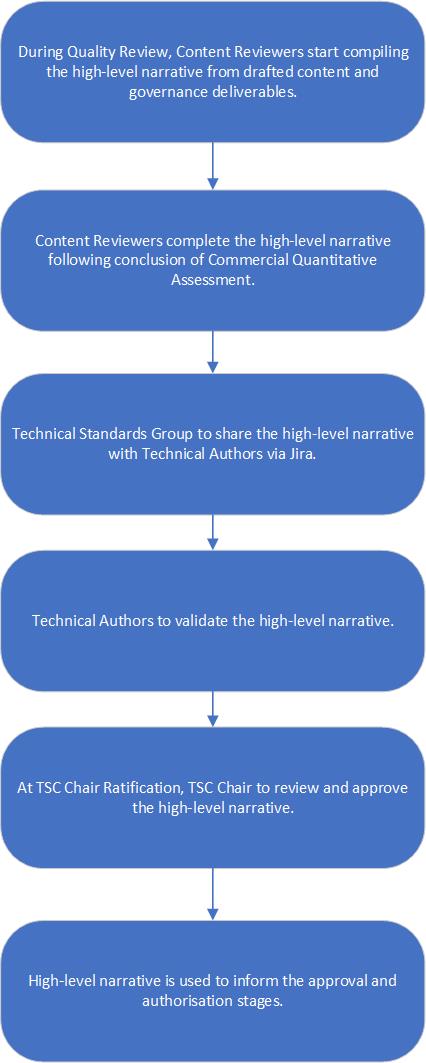
As part of the MCHW refresh programme, the high-level narrative will be compiled by the content reviewers during the quality review stage and validated by the technical authors. Once the MCHW refresh programme is complete, the MDD rules will be updated to incorporate roles and responsibilities relating to the high-level narrative in routine document development and maintenance.