
Contents
Issued 21.11.23 – The FAQ has been updated with responses raised at the DMRB and MCHW update webinar. New questions and answers are numbered 5.6, 8.11.
Issued 30.10.23 – The FAQ has been reviewed in its entirety to ensure only accurate information is present on the help pages, to avoid confusion as we progress towards the publication date. Some of the previous FAQs have been deleted where out of date, or re-worded for clarity. Those items/sections that have been deleted are ‘Document Development Plan – Timescales’, ‘Document Development Plan – Support’, ‘Technical Project Board and the new streamlined governance’. Those that have been re-worded are numbered 1.2, 3.1, 3.2, 3.5, 3.7, 4.2, 4.3, 4.4, 4.5, 4.6, 4.7, 4.8, 4.16, 4.19, 4.24, 4.27, 4.29, 5.1, 5.2, 5.3, 6.1, 6.4, 6.5, 6.9, 7.15, 7.16, 7.17, 7.18, 8.1, 8.3, 8.7, 8.9, 8.10, 9.2.
Issued 17.8.23 – The FAQ has been updated with information related to a high level narrative document to support the approvals of MCHW documents. New questions and answers are numbered 8.12 – 8.15.
Issued 14.8.23 – The FAQ has been updated with responses raised at the DMRB and MCHW update webinar. New questions and answers are numbered 5.10 and 9.20.
Issued 21.4.23. The FAQ has been updated with responses raised at the DMRB and MCHW update webinar. New questions and answers are numbered 7.6, 7.7, 7.8, 8.10, 8.11, 9.19.
Issued 8.8.22. The FAQ has been updated with responses raised at the DMRB and MCHW update webinar. New questions and answers are numbered 6.36, 8.8, 8.9, 10.10, 13.2.
Issued 26.4.22 – The FAQ has been updated with responses to queries raised. New questions and answers are numbered 6.35.
Issued 29.3.22 – The FAQ has been updated with responses to queries raised. New questions and answers are numbered 1.2, 5.8, 5.9, 6.31, 6.32, 6.33, 6.34, 8.5, 8.6, 8.7,10.7, 10.8, 10.9.
Issued 21.03.22 – The FAQ has been updated with responses to queries raised. New questions and answers are numbered 9.16 and 9.18.
Issued 17.02.22 – The FAQ has been updated with responses to queries raised. New questions and answers are numbered 9.16 and 9.17.
Issued: 26.10.2021 – The FAQ has been updated with responses to queries raised at the MCHW rewrite drop-in sessions and the MCHW authoring training 05.10.2021. New questions and answers are numbered 6.28, 6.29, 6.30, and 9.15.
Issued: 25.06.2021 – This FAQ contains responses to queries raised at the MCHW Document Development Plan training, the MCHW rewrite drop-in sessions and the MCHW authoring training.
This FAQ will be kept up to date throughout the delivery of the MCHW review programme. Please provide any feedback and comments to Becky Ansell – rebecca.ansell@nationalhighways.co.uk
We have set up weekly 45 minute drop in sessions, every Tuesday, 11.00 to 11.45, for you to ask questions on the MCHW rewrite. Do join us and take the opportunity to share your views and lessons learned. Click here to join the meeting
Lessons from the DMRB
Are we considering the lessons learned from the DMRB update programme in the MCHW refresh?
As part of our continuous improvement process, Technical Standards Group (TSG) is building upon lessons learned from the DMRB project to deliver the MCHW review programme. We have a detailed risk register (and associated mitigation measures) and opportunity register, which has been drawn from the work done on the DMRB and targeted to the needs of the MCHW.
Key areas we are focussing on:
- Planning, including work programme and Document Development Plan;
- Resource mobilisation;
- Drafting rules;
- Digitalisation;
- Publication;
- Streamlined governance process;
- Impact on the DMRB; and,
- Engagement with all relevant stakeholders, including Devolved Administrations and other National Highways’ Directorates (MP, Operations, Commercial, etc.).
Following experience from the DMRB, how are the cost implications on projects due to the MCHW updates being considered?
[29.03.22 – amended 30.10.23] A robust governance is in place to assess impacts of RAD updates. Each RAD goes through a detailed impact assessment where commercial implications (including capital costs) are just one of the components. We are concerned about whole life costs alongside health & safety, environmental, customer and other key impacts. Impact assessments are then reviewed and commented on during the TSC consultation stage by all relevant stakeholders.
Please note that cost impacts of adoption of updated standards on existing schemes is part of the decision process (see GG 101 Implementation clause), hence they should be assessed and managed at scheme / project level as relevant.
We encourage feedback on standards, therefore please share any examples of increase in capital costs so they can be assessed by technical authors and considered for the next document review.
Document Development Plan – Development
Is the Document Development Plan mandated in the MCHW programme or advisory as it was for DMRB?
The Document Development Plan (DDP) is a mandatory deliverable for all document development works involving major document revisions or new document development (new rule that will be introduced in the next version of the Manual for Development of Documents).
What we learned from the DMRB programme was that spending time and thought upfront to carefully define the precise brief and then working in a way that imposes some discipline in adhering to it, is essential to avoid significant rework later on in the process. The DDP is also essential to identify critical areas, understand the effort required, and mitigate the risk of underestimating the work involved.
Back to topWhere will the Document Development Plan (DDP) be drafted? Is there a template?
The DDP will be developed in Word using the template provided in each Series folder saved here. In that way you will be able to upload and collaborate on your DDPs. SharePoint supports collaboration and multiple users working on the same document. It also helps document version control and enables all contributing to a DDP to use the latest document version.
Back to topWill JIRA be used to draft the Document Development Plan (DDP)?
No. Jira is our programme and workflow management tool, and is not suitable to draft the DDP. Jira is however used for approvals and audit purposes in order to progress to the next governance step.
Back to topWill CARS be used to draft the Document Development Plan (DDP)?
No. CARS is our collaborative authoring and review system targeted to draft DMRB and MCHW documents. It is not suitable to draft the DDP. To support collaborative virtual working, the DDP will be developed in Word and uploaded on SharePoint so that it is accessible to multiple people at the same time.
Back to topIs the Document Development Plan (DDP) for MCHW the equivalent to what the change log was for the DMRB?
The change log and DDP are different deliverables and serve different purposes. The DDP outlines drafting needs and approach, high-level changes for each section, and what the final document structure will look like. It is used as a planning tool and will be mandated for both DMRB and MCHW documents involving major document revisions or new document development. The change log provides information about the changes made to each Clause of the old document (e.g. whether content was deleted or moved somewhere else). It is used for audit trail purposes. The change log is required for both DMRB and MCHW documents.
Back to topIn the future MCHW we need to make a clear distinction between requirements for designer and instructions for specifier. However, designer and specifier roles can be blurred and interactive e.g. in design and build contracts, so it may be difficult to clearly separate as proposed. How can this issue be overcome?
There are two interactions to consider:
- The difference between design activity and specification activity, where we are making a clear distinction by putting all design requirements into the DMRB design row and the specifier instructions under a new row; and,
- Specification (i.e. works specific inputs) produced at different stages depending on the contract types, e.g. outline specification produced by the scheme design team to enable a Design &Build tender compared with construction specification produced by Design & Build design team.
One of the principles in the MCHW update is contract neutrality. Therefore, although the act of producing the specification may occur at different stages, the focus of drafting the new MCHW based around roles (i.e. designer vs specifier vs constructor) should enable this to happen.
Back to topWhat is the distinction between ‘design activity’ and ‘activities related to products’?
Activities related to products and materials include:
- Construction activities required to ensure that products and materials are correctly installed (installation/workmanship requirements);
- Verification (including testing and inspection) to prove that products and materials are acceptable; and,
- Documentation to prove that other requirements have been carried out.
A design activity / decision is taken by the designer about the following:
- Choices on classes;
- Choices that affect performance;
- Selection / optimisation against multiple criteria; and,
- Decisions which affect other products / materials / activities related to products and materials (i.e. interfaces).
Activities related to products and materials are relevant to the SHW. Content related to design activity / decision has to be extracted and from the MCHW and moved to the DMRB design row.
Back to topWho is responsible for identifying differences and (re)drafting the clauses for the Devolved Administrations?
National variations shall be identified at Document Development Plan stage by the document owner so that you can start engagement with the Devolved Administrations and discuss opportunity for removing them / harmonising content across the four Overseeing Organisations. Drafting nationally determined requirements or sections will be responsibility of the relevant Overseeing Organisation.
Back to topWhat should I do when reviewing Volume 3 drawings at Document Development Plan (DDP) stage?
Please see slides 61 and 62 in the DDP training session. Overall you have to identify the status of each drawing considering a few aspects listed in slide 61, and relevant location of drawings as indicated in slide 62. Suggestions for making the drawings legacy documents with no further changes needed should also be identified.
Back to topAuthoring the future MCHW (general)
Will training for authoring be provided and when?
[amended 30.10.23] Training for authoring was provided in 2021/2022. Recordings of the training videos are available on the help pages: https://help.futuredmrb.co.uk/i-am-a-brand-new-author-of-mchw-documents/#MCHW_authoring_training_slides
Back to topWhen shall we expect the new Manual for Development of Documents (MDD) drafting rules to be available?
[amended 30.10.23] The MDD was published in March 2021. The current version can be found under “Reference Material” on the help pages.
Back to topWill CARS be used for authoring the future MCHW (SHW and instructions for specifier)?
Yes. CARS developments started in July 2020 to introduce the changes needed to author the future SHW / instructions for specifiers documents.
Back to topDo the Devolved administrations have the resources to support the drafting programme?
The Devolved Administrations, Heads of Standards have been involved in the project since its inception and their staff will be attending the training sessions. Technical Standards Group (TSG) will be running monthly progress calls with the Heads of Standards to discuss progress made and check whether there are any concerns on resources. Anything which could affect the programme will be fed back to technical authors and options for reducing risks will be discussed, with resolutions being put into place as appropriate.
The update of the MCHW in RIS 2 is a National Highways protocol licence requirement (not a Devolved Administration requirement). Therefore, we should be flexible when it comes to developing nationally determined requirements and sections, and accept that there may be times where we may have to assist the Devolved Administrations.
Back to topWhen authoring the MCHW in CARS, do we produce a single document that includes both the SHW requirements and the Instructions for Specifiers?
[amended 30.10.23] Yes, this is correct – do not worry about what to call the document or how it will be published as this will be determined later in the programme. The CARS MCHW templates allow ‘author once, publish twice’ functionality. The ‘P’ row of the technical standards matrix – target audience: specifier – will be published with both the SHW requirements and IfS. The ‘C’ row the technical standards matrix – target audience: constructor – will be published with only the SHW requirements. The contract specification will be made up of the SHW and work specific inputs (which are populated by the specifier completing the instructions in the IfS).
Back to topAre figures not allowed in the appendices?
In the current MCHW figures are not used in the sample contract specific appendices. In the new MCHW the contract specific appendices will be transferred to the work specific inputs where figures will not able allowed, although a reference to drawings can be made (which is currently allowed in the contract specific appendices).
Back to topThe new DMRB format makes it very clear where requirements are mandatory. Would it be the intention that a similar format, and therefore a very clear distinction between requirements and advice, will be applied to MCHW?
[29.3.22 – amended 30.10.23] Specific drafting rules have been developed for the MCHW, following a similar approach to the DMRB. The new SHW will only contain requirements, no advice. The Notes for Guidance will be completely changed into Specifier Instructions.
Back to topThere is content in the MCHW which does not belong to it, and that does not have an obvious location in the DMRB. Where will it be maintained?
[29.3.22] Please provide examples of content which does not seem to have an obvious location to Technical Standards Group (TSG).
Back to topWill the MCX drawings be updated as well as the HCD drawings?
HCD and MCX are either being incorporated into relevant SHW docs, moved to DMRB as ‘examples’, or archived with no replacement.
Back to topMCHW specific drafting aspects
Will there be overarching requirements for checking CE / UKCA certification, or does this need to be included in each of the product parts? If the latter, will there be standard text?
There will be overarching requirements, which would not need to be repeated for each product (as is the case with the existing document – Clause 104). The current hierarchy is likely to stay as follows:
- Products covered by a harmonised standard – required to be CE marked and the declaration of performance submitted;
- Products covered by a standard that is not harmonised – required to be certificated under a Product Certification Scheme (or ETA);
- Products not covered by a standard – required to be certificated to a Product Acceptance Scheme where schemes exist or comply with the specification requirements; and,
- Products that don’t come under the scope of a standard or product acceptance scheme – to comply with the specification requirements.
Standard format requirements will be used to cover the above.
Back to topHow should document owners take account of local roads in Northern Ireland in the MCHW?
[amended 30.10.23] GG 101 has been updated and a Northern Ireland NAA has been drafted to clarify that the Northern Ireland requirements apply to all roads.
Back to topIs maintenance a design or service?
[amended 30.10.23] A key principle is that information should be provided in reasonably expected places depending on the audience and aligned with other comparable content. In this specific case it is useful to make a distinction between design for maintenance, which is relevant to designer (design row in the matrix, part of the DMRB), and the information that is relevant to those responsible for maintenance (Maintenance & Operation, part of the DMRB).
Back to topWhat about requirement cross-referencing between different series?
[amended 30.10.23] This has been covered at the training sessions for authoring.
Back to topWhat will happen to Volume 3?
[amended 30.10.23] The current volume 3 drawings will become either:
- Updated technical drawings in the DMRB;
- Updated technical drawings in the SHW;
- Updated technical drawings retained in a separate set; and,
- Archived available on the website.
Please see the Manual for Development of Documents part 3, section 6 for further details.
Will National variations be presented as National Application Annexes (same as DMRB approach)?
[amended 30.10.23] In the future MCHW, national variations will be called ‘Nationally Determined Requirements’ (NDRs) or ‘Nationally Determined Sections’ (NDSs). This depends on whether there is limited, small variation (which can be presented at requirement level) or significant variation (which will require an entire section to be presented).
Back to topHow do I manage design content currently contained in the MCHW?
[amended 30.10.23] Please see slides 34 to 38 of the Document Development Plan training. Specific guidance was also provided during the training for authoring sessions. If you have any comments in the meantime, please contact Technical Standards Group (TSG).
Back to topHow will the carbon agenda be dealt with in the MCHW?
[amended 30.10.23] Members of TSG and SES’s Sustainable Development and Good Design team have been collaborating on how the low carbon future can be supported by the MCHW. This has expanded to include the DMRB and procurement. The new streamlined governance process, was released in late March 2021, and has an impact assessment report containing a screening procedure with regards to carbon for new documents and those that require significant amendments. The screening procedure will determine the level of advice given to technical authors from the Sustainable Development and Good Design team in respect of reducing carbon.
This has also resulted in several requirements being drafted in the Manual for Development of Documents to provide guidance to technical authors on whole life carbon management and the creation of greenhouse gas emissions. We will draw on European standards, British standards, GG 103 Introduction and general requirements for sustainable development and good design, and LA 114 Climate to utilise sustainability and low carbon best practice. Sustainable Development and Good Design team and TSG have also commissioned a supplier to create a library of the most used items in the MCHW and their carbon lifecycle credentials. This library will be available to technical authors as a guide when authoring documents.
In mid-2021 Highways England published its ‘Net Zero’ plan. Members of TSG will continue to work with the Sustainable Development and Good Design team to incorporate the findings of ‘Net Zero’ plan into the MCHW project (and DMRB and procurement). In doing so, we understand that sustainable development and carbon management is a continuous process and throughout the documents we develop we will constantly pursue a balance between economic, social and environmental variables.
Back to topIs advisory content allowed in the DMRB?
Yes, advisory content is permitted in the DMRB in support of a requirement where associated with a requirement, giving an indication for a solution for which the Overseeing Organisation has no strong views: using ‘may’ for permissions, ‘should’ for recommendations, or ‘can’ for notes.
Back to topIs Overseeing Organisation acceptance a matter we need to look to move away from in DMRB as well?
For the MCHW this is a particular issue with approval of aspects during construction, which has the potential to delay progress of the works which could lead to financial claims or prolongation of the programme. Where acceptance is required by the
Overseeing Organisation in the DMRB, it would have to be reviewed on a case-by-case basis. It is recommended cases of acceptance by the Overseeing Organisation within the DMRB are discussed with TSG.
The rational behind this is based on risk management of Professional Indemnity insurance; which National Highways does not have. How is ‘acceptance’ demonstrated? Is it a signature in a box which brings personal professional liability (which could test corporate indemnity)? Can the documents be ‘submitted for comments’ and then acknowledged? If National Highways is the ‘checker’ or ‘approver’ the ownership of risk can change resulting in National Highways becoming liable for some element of the design (or part of the works). (This doesn’t affect ‘Checking’ such as category III checks by a third party.)
Back to topShould standard format requirements (SFR) be retrofitted to the DMRB?
Lessons learnt on developing the drafting rules for the MCHW and their subsequent implementation through CARS will be reviewed and where it is thought to be advantageous implemented on the DMRB. The use of national application annexes or changing to SFRs is a priority for review.
Back to topWhere international and European ‘legislation’ has not been endorsed by the UK, will the requirement still be a ‘must’?
The UK is subject to a lot of laws, not all of them are ‘endorsed’ by UK government. Everything that was European Union law on 11:59 31/12/2020 became UK law 00:01 01/01/2021, there is no endorsement required. International law is a mix of treaties and conventions, custom, general principles of law, and judicial decisions and teachings. The UK is still subject to World Trade Organisation treaties which includes: The General Agreement on Tariffs and Trade (GATT), covering international trade in goods; the General Agreement on Trade in Services (GATS); and the Agreement on Trade-Related Aspects of Intellectual Property Rights (TRIPS).
Yes, the verb form shall be a ‘must’; they must comply with the law – if someone breaks the law they will be held accountable. The ‘must’ ensures that a party does something that National Highways could be held accountable for in a court of law if it isn’t done. It doesn’t matter which law or which court.
Back to topWhat happens where there may be legitimate options open to the constructor? How do we express permitted alternatives?
Options or permitted alternatives can be expressed by using ‘shall’ and then including a list of options (see example below). Where necessary this may require references to other parts of the specification or external documentation. Where the options are site specific they can be included in the work specific inputs for selection by the specifier.
Example
Brick bonds shall be:
- Stretcher bond;
- English bond; or,
- Flemish bond.
This assumes that the choice between options is ‘equal’ or ‘equivalent’. If the choice between options is not equal, then it may need further thought about whether this is actually a design decision rather than just a selection of a product or material that complies fully with the design and works specification.
We need to be careful using this approach as explicitly providing options can be a limit to innovation. For every entry on a list, there are always other options. If a problem has a limited list of solutions, then we are blocking innovation. A better approach would be to specify the ultimate outcome clearly and the performance required. What do you want the performance outcome to be (not what is a list of solutions)?
Back to topIf the incorrect standard format requirement (SFR) is selected, do you have to bin the document and start again?
Not the whole document, although you will have to delete the whole SFR. SFRs refer to specific requirements. If the incorrect SFR template is selected it can be deleted and the correct one selected. However, the user input fields do not map cleanly when swapping between SFR templates; due to each template having a specific requirement function. The user input fields can be copy and pasted from one user input region to another. Therefore, if the correct SFR template is added before deleting the incorrect one, the user input fields can be easily copy and pasted from the incorrect SFR to the correct SFR. Once all the user input fields have been transferred, the incorrect SFR can be deleted.
It is possible to select any requirement and see what it looks like in the right-hand viewing pane. It might be advantageous to insert two or three SFR that look to satisfy a particular requirement, try them out and then delete the ones which are not suitable.
Back to topWill it possible for a specifier to add something that is not covered by the instructions for the specifier or work specific inputs, i.e. something which we have not thought about in preparing the SHW, instructions for the specifier and work specific inputs?
Yes, although this will require a Departure for ‘an aspect not covered by requirements’. This is required so that National Highways have sight of all processes or products that are being installed on the network. This will then be incorporated into the specification through an additional clause (AR), substitute clause (SR) and cancelled clause (CR) (see NG003.10 and NG sample contract specific appendix 0/1: contract specific additional, substitute and cancelled clauses, tables and figures included in the contract).
The use of CARS and the Technical Standards Enterprise System will allow the new MCHW to be update much more quickly (the same as the DMRB). So, if there are several Departures submitted around the same subject, which warrants that subject being included in the specification it can be done so much more quickly.
Back to topIs testing table automatically updated? Will contract specific appendix 1/5 cease to exist?
[amended 30.10.23] No, all verification testing requirements currently contained in Table NG 1/1 which are still considered by the technical author to be a necessary part of the specification should be transferred into the verification requirements of their specification documents. Series NG 100 Table NG 1/1: Typical Testing Details will be deleted, as will appendices 1/5 and 1/6 which were edited by the specifier to produce the contract-specific testing schedules. Contract specific appendix 1/5 will no longer exist as an appendix, instead testing requirements will be integrated into the relevant document as part of the Work Specific Inputs, and summary tables such as appendix 1/5 may be extracted automatically as part of the contract compiling process. If the verification requirements are not transferred, then they will no longer form part of the standard specification. A range of ‘verification’ and ‘documentation’ standard format requirements have been developed to replace Table NG1/1 at an individual document level. All contract compliance verification and testing to be undertaken by the constructor should be identified in the requirements, explained in the IfS and included in the WSR
Back to topWhat about the use of the term ‘safe’?
The term ‘safe’ is open to interpretation. Compliance with a relevant BS could be assumed to provide something which is ‘safe’. However, providing something which is ‘safe’ could be a far more complex interdisciplinary consideration which needs to be scrutinised as a design aspect under GG104 rather than in the specification. In the specification it would be better to list our requirements in terms of the verification and documentation we are expecting the constructor to provide, as this is not open to interpretation.
The specification should not tell the constructor how to undertake their working practices; this is what the constructor is paid for. Specifying the method of working to the constructor can cause the transfer of risk and liability to the Overseeing Organisation when they are not the best placed to manage it. For example: if the specification refers to how the constructor should operate a tunnel ventilation system; the constructor operates the ventilation system in accordance with the specification requirements; and this doesn’t create a safe environment which leads to an incident – where liability apportioned?
Back to topWhere there is currently advice that uses ‘should’ in the MCHW; should this become a requirement using ‘shall’ or removed from the SHW?
Every requirement that remains in the SHW will use the term ‘shall’. If using ‘shall’ is not appropriate for the existing Clause and the advice is still considered relevant – in many cases the advice actually concerns design decisions – it shall be transfer to DMRB.
There are some instances in the SHW where ‘may’ is used to express permitted alternative options. It is possible to redraft ‘may’ Clauses as ‘shall’ requirements and still give the constructor a list of permitted options (FAQ 6.16). The reason for this phraseology is to avoid ambiguity which can be exploited contractually. (Most forms of contract, which the specification becomes a part of, do not allow for the terminology such as ‘should’. ‘Should’ is persuasive and becomes extremely difficult to price, demonstrate compliance and enforce minimum performance.)
Back to topIn relation to a Clause such as, ‘the Contractor shall design the corrugated steel buried structures listed in Appendix 1/10 in accordance with Standard BD 12 (DMRB 2.2.6) and the design requirements given in Appendix 25/1’; how is this dealt with in the new MCHW format?
[amended 30.10.23] Constructor design is covered by one of the standard format requirements – essentially it will remain very similar in nature to the example you have given i.e. there will be a requirement on the constructor to design the element in accordance with the relevant DMRB requirements. Although this requirement will be dealt with at a document specific level, rather than referring to contract specific appendix 1/10.
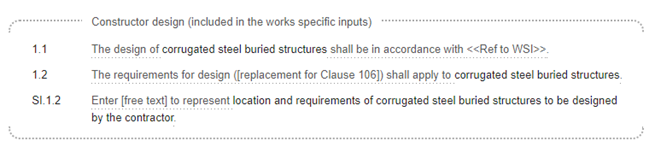
The work specific requirements (WSR, formerly WSI) will include a generic reference for design to be in accordance with the DMRB i.e. the DMRB is the default position.
Back to topHave the impacts of requirements for things that are not physical objects – such as software and control systems – been considered?
A performance specification for the outcomes of individual software systems should be able to be written within the principles set out in the Manual for Development of Documents. However, the specification of the outcomes of the control system and the interaction between the individual software systems to optimise the conditions in / on the asset might be more difficult. It may be the case that we require some additional standard format requirements. Please contact TSG when authoring the control system requirements for further guidance.
(The Network and Information Security directive and Centre for Protection of National Infrastructure may restrict the providing of software and control system information on a publicly available website.)
Back to topSeries 3000 Landscape and Ecology is used for maintenance as well as construction – does that complicate things?
Clauses in the MCHW which are directed towards maintenance just require further consideration with regards to who is the ultimate audience – the constructor or the party undertaking assessment or the design of the maintenance treatment. If the audience is the constructor, then the Clauses should remain in the new MCHW. If the Clauses are directed towards another audience, they should be included in a discipline specific document (or a new document) in the technical standards matrix.
Back to topTransport Scotland use MCHW Series 3000 for the contracts for the operating companies that manage the existing network – would the operating companies be considered Constructors?
Yes, the operating company in this instance would be considered a constructor as they would be employed through a term service contract or similar. (Parties to a term service contract are the Employer, Contractor (company providing the service) and Service Manager (project manager).)
Back to topWhat is meant by the term verification in the SHW?
Verification is the generic term being used to mean any activity, that needs to be specified, that is about checking or verifying the work rather than actually providing the works. This text is from the draft for the SHW preliminaries documents with respect to verification – ‘Where the specification requires verification activities including testing, checking, inspection, examination, measuring, monitoring, trials, and demonstrations these shall be undertaken by the Contractor unless otherwise stated.’ Thus, it applies to products as they arrive on site, installation and the installed products, it applies to verification activities at all stages of the contract.
Table NG1/1 will no longer be included in the contract through contract specific appendix 1/5, so any verification activities contained in table NG 1/1 should be moved to your new document. This is in a bid to reduce ambiguity, as the current MCHW has verification requirements within Table NG1/1 and some in the individual Series documents. Placing all the verification requirements in each disciplines’ document gives the technical authors sole control over the verification requirements and subsequently not having to request changes to NG 100 which is owned by TSG. Examples of verification include concrete sampling and crushing the cubes at given timescales, coring pavement layers, and CCTV surveys of ducts or pipes to confirm they are there, whole, and free from obstructions. Verification may also include the commissioning of systems.
Verification should be happening at a variety of levels:
- Component installation level, ensuring all the components are in the right place and installed correctly i.e. the ERT is correctly assembled;
- The job / task level where the completed asset is installed correctly i.e. the ERT is in the right place on the network, and vertically aligned;
- The scheme level where all completed assets are checks to ensure that they are working as intended; quality control where selected assets are scrutinised to ensure all of the steps have been carried out correctly.
The SHW needs to detail all the verification requirements to be placed onto the constructor (i.e. Overseeing Organisation verification should not be detailed in the SHW).
There are different purposes for the verification:
- Verification to demonstrate that a process has been followed;
- Verification that a task has been completed correctly;
- Verification regarding quality of workmanship / installation;
- Verification of products / materials.
It is up to the specialist to decide where failure will result in a product or outcome that does not meet our needs. Consideration could be given to improving the management of the quality of National Highways works, to improve the outcomes of the work and to the paper trail for provision of evidence. Verification is evidence that something has been carried out and the outcome checked against a set of criteria. The severity of the outcome of failure to get the works right would dictate the approach to the verification e.g. the format, the frequency and the need for third party involvement. We should perhaps be getting into the mindset of: do something; check it; record that it has been checked and that it has; or has not; been done correctly.
Back to topWhat format is the verification intended to take, who does the verifying, where does the verification documentation go, and who is in receipt of the verification and what are they expected/supposed to do with it?
The format of the verification should be what is necessary/appropriate for the item(s) being checked / tested / measured etc. i.e. what does the site team need for checking contract compliance, what does NH need to demonstrate that due diligence has been undertaken, what does NH need for operational purposes. The documentation of these verification activities could need to be provided as evidence in adjudication, arbitration, or further legal proceedings (similarly they could be provided to the coroner).
As with the existing specification, what is necessary / appropriate for the different technical specialist areas will be different for each technical area and it is unlikely that a generic template could be established that would actually be of any use. The technical authors need to identify what is specifically required for their technical area. This could be for holding the contractor to contract compliance or for asset databases for future maintenance; drainage have HADDMS and structures have SMIS each of which require documented verification in different formats.
The technical author should be considering what needs to be checked / tested / measured before it is covered up or whilst easy access is available. It is intended that the SHw preliminary documents will say ‘all verification shall be documented’ and ‘all specified documentation shall be submitted’ – documentation in the first instance will be submitted to the Project Manager for the project, which will then, usually on completion of the scheme, be forward to the appropriate place in NH (this is currently how it operates in the SHW).
Not all constructor requirements need to have verification requirements but the technical authors should be considering if verification is required for each constructor requirement. The linking tool in the CARS template is intended to assist with this, although forms no part or has any functionality when the documents are published (it is a checking tool for technical authors, content specialists, and reviewers).
Verification will be specific to the requirement, and what is to be verified, at the task level it could be as simple as a simple pass / fail check and a checkbox on a job sheet. At a scheme level, the verification could be simply the accumulation of the job sheets to demonstrate that the pass / fail test has been carried out for each installed asset, evidence that 1 in 10 have been rechecked and the evidence to demonstrate that all of the installed assets work as intended.
Back to topWhen should the constructor design SFRs be used?
Constructor design should be detailed where there is an expectation that the constructor needs to apply a design standard to their decision-making process and thus, we need to instruct the use of the design standard we want them to use, i.e. the relevant bits of DMRB. ‘Constructor design’ is the replacement of the existing Clause 106 and contract specific Appendix 1/10. Clause 106 gives time periods for acknowledgement by National Highways for works designed by the constructor, therefore the constructor cannot just change design details as and when they please. This will be maintained in the new SHW, although can be altered by disciplines in their documents if they wish i.e. extended or reduced from the usual six weeks
Back to topThere is an overarching concern about the amount of useful information/guidance/practice which may be lost through the MCHW update. How are you mitigating the risk of information loss? Is there a proposed place to relocate this information?
[29.3.22] The content of the Notes for Guidance will be carefully assessed by technical authors / specialists. Helpful content will not be lost, it will be redrafted and located in the appropriate place. Information useful for the specifier will be retained in the Instruction for Specifier documents and re-drafted following the new rules, which make it clear the link with the relevant SHW clauses and WSI. Information that is relevant to designers will be migrated to the relevant DMRB documents or new documents will be created as relevant. NG will be archived anyway so if you want to look at it in the future you can. If there are any specific concerns on information lost, please contact Technical Standards Group (TSG).
Back to topWhat should I do if I am finding it difficult to work out where existing content in Notes for Guidance should go?
[29.3.22] Please provide examples of content which does not seem to have an obvious location in the DMRB to Technical Standards Group (TSG).
Back to topDo you have any guidance for how I draft Specifier Instructions in CARS?
[26.4.22] Please see this guidance video taken from an MCHW drop in session on 26.4.22: Top tips for creating Specifier Instructions in CARS.
Back to topAre mandatory non negotiable specifications locked in and not able to be diluted nor omitted?
[8.8.22] Yes unless a departure is granted. DAS is to be linked to enforce this.
Back to topWork Programme
Is a work programme available to update the MCHW?
The work programme has been captured on Jira and delivery dates have been agreed with technical authors.
Back to topWill there be a standardised ‘naming protocol’ for new draft DMRB and MCHW documents as I would like to differentiate between the DMRB documents already in CARS and the new set of draft DMRB documents I will need to create in parallel with overhaul of the MCHW?
[amended 30.10.23] There can only ever be one live document on CARS for each DMRB document and it’s important to keep updating the same one to create the versions on the website (and for future use of html instead of PDFs). Incremental updates to the DMRB should continue as normal throughout RIS 2, to allow for the incorporation of feedback, technical changes and where there is a business need. If you find that you have started drafting an update to the DMRB document in CARS that needs to be delayed in favour of the more urgent requirements from the MCHW update, please consider using the revert version functionality. Please contact TSG if you need any further assistance.
Back to topI am proposing to outsource the delivery of the MCHW documents; will there be training for the supply chain?
[amended 30.10.23] Training for authoring including for the supply chain was provided in 2021. Recordings of the training videos are available on the help pages: https://help.futuredmrb.co.uk/i-am-a-brand-new-author-of-mchw-documents/
Back to topWhy can’t the MCHW programme be levelled to reduce the workload peak in November 2023?
The programme is developed based on dates provided by TSC chairs (following a recent reforecasting activity). To level the programme would require dates to be brought forwards which brings its own challenges. The final decision is with SES senior leaders.
Back to topWhat happens if the programme dates are missed?
The requirement to modernise the MCHW in accordance with the review completed in the first roads period (2015-2020) is a National Highways commitment to Government as part of the Technical Regulations Protocol attached to our licence. The Office for Road and Rail monitor progress and will assess whether we meet the requirement at the end of the second roads period (2020-2025). Non-completion will affect the reputation of National Highways.
Back to topHow is the the programme risk related to comments generated by the commercial and quality reviews being managed?
Tailored support is being provided to improve the quality of governance deliverables in advance of the review stages to reduce the number of comments. Please refer to the webinar recording for further details.
Back to topResources
Have the Devolved Administrations been engaged and are they aware of the MCHW update work?
[amended 30.10.23] Yes. The Heads of Standards in the Devolved Administrations are aware of the MCHW rewrite programme and have been invited to the Document Development Plan training and the collaborative planning workshops. They have asked for the programme of work so that they can assess the workload of their staff. Regular meetings are held with the Heads of Standards to keep them abreast of the programme.
Back to topHave other Directorates like MP and Operations been engaged and are they aware of the MCHW update work?
Yes. There has been consultation over how they use Volume 3 and what initiatives they have going forward with regards to standard details. However, further work needs to be undertaken and there will be further engagement undertaken throughout the project.
Back to topWhere can I find information to refresh my knowledge of the training materials?
[29.03.22] Please see our revised CARS help pages for quick access to relevant training materials and videos based on roles: https://help.futuredmrb.co.uk/quick-links-per-topic-role/
Back to topWhat about specific training on supporting decarbonisation please?
[amended 30.10.23] There is specific internal carbon literacy training for NH staff. Please see your Thrive e-learning account.
Back to topWhere can I find more information on the process of reviewing vol 1,2,3 drawings please?
[amended 30.10.23] Please see the training video on figures here: https://help.futuredmrb.co.uk/i-am-a-brand-new-author-of-mchw-documents/#Training_on_figures Additional guidance can be found in MDD part 2 section 9. For any further questions please feel free to join our MCHW drop in session. Please contact Technical Standards Group (TSG) for an invite.
Back to topAre there any further training sessions available on drafting rules in the Manual for Development of Documents in future?
[8.8.22] There are no plans to run any further live training or refresher training sessions on drafting rules in the Manual for Development of Documents, but all previous training sessions have been recorded and are available to view on the Help pages:
https://help.futuredmrb.co.uk/i-am-a-brand-new-author-of-dmrb-documents/
https://help.futuredmrb.co.uk/i-am-a-brand-new-author-of-mchw-documents/
https://help.futuredmrb.co.uk/i-am-a-technical-author/
The drop in sessions are also available for MCHW drafting queries (Tuesday mornings) and Jira/governance queries (Alternate Tuesday afternoons). Please contact rebecca.ansell@nationalhighways.co.uk to be sent an invite.
Could a statement about the ‘criticality’ of meeting the overall programme that can be directly used to justify the emergency of direct awards in the 23-24 financial year for authoring and comment reviewing support be provided?
Text can be made available, please contact TSG. Decisions on whether to allow a direct award is still a matter for the Procurement team.
Is there a draft commissioning document for authoring support contracts to save us time?
Please contact TSG to discuss your specific needs.
Back to topWhat is the high-level narrative?
[amended 30.10.23] For the MCHW approval process, the Chief Highways Engineers/Chief Roads Engineers (CHE/CRE) need a clear narrative of changes and impacts. This information will be compiled into a high-level narrative. For more information see the help page https://help.futuredmrb.co.uk/how-to-create-a-high-level-narrative-document/.
Back to topWill a high-level narrative be required for other change items including the DMRB?
This High Level Narrative template will be trialled initially for the new MCHW documents only due to the need driven by the document development programme. If considered useful, it may be subsequently rolled out as a standard governance deliverable. If so, further information and an update to the MDD will follow. Regardless, it is essential to be clear on the key changes and associated impacts. Some disciplines are already compiling a narrative of key changes to support the consultation process, the High Level Narrative template may be used for this purpose including for other (non-MCHW) changes.
Back to topWhy can’t I use my separate key changes narrative?
A consistent High Level Narrative template is being adopted for the MCHW to support the approvers and authorisers as they will be reviewing many documents from multiple disciplines. If you have already compiled a separate key changes narrative this should expediate the task of completing and verifying the High Level Narrative.
Back to topVision, structure and content
What is the vision for the future MCHW? How was it derived?
A consultation with the UK construction industry was undertaken in 2018. Based on the findings of the consultation, a high-level recommendation and 15 specific recommendations were identified. These are provided into a recommendations report. An executive summary has been shared here https://sauksprodtsespublication.blob.core.windows.net/cars-wordpress-uploads/2022/02/MCHW-Review-Phase-3-Recommendations-Report-EXECUTIVE-SUMMARY.pdf, which also contains a summary of the consultation report.
The recommendations have been translated into the following vision statement: ‘The future MCHW will provide clear and unambiguous requirements and instructions, compatible with modern contract forms and future construction practices.’
Back to topThe new structure appears much clearer, do we maintain DMRB approach to requirements, advice and notes / information?
We will follow the same approach as for the DMRB in terms of clarity and conciseness of content. However, we will not have the requirement / advice / note hierarchy that we have in the DMRB as it is not relevant in the MCHW context. The Specification for Highways Works will only provide requirements for constructors. The Notes for Guidance content will either migrate to the DMRB (when providing advice on design aspects), or stay in the Instruction for Specifier documents and be rephrased as pure instructions without supporting advisory content.
Back to topAre the notes for guidance still required?
Yes. However, the Notes of Guidance will change significantly to become Instructions for Specifier documents. The content that is relevant to the specifier will stay in the Instructions for Specifier documents. The content on design activity / decision will move to the DMRB.
Back to topIs the MCHW going to change name in recognition of the significant changes that will be made?
No. There won’t be a need to change the title of the MCHW as in future it will be consolidated in the technical standards matrix. As illustrated in the Document Development Plan training, eventually the Specification for Highways Works documents will be incorporated into the ‘construction’ row of the technical standards matrix, whereas the Instruction for Specification documents will be provided into a new row of the technical standards matrix.
Back to topWhat format will the health and safety content take and where will it be located?
Current health and safety content is provided in Volume 6, i.e. IAN 105 and SA 8/94. IAN 105 is already being rewritten as GG 106. SA8/94 requires significant review and can potentially be withdrawn as it pre-dates a lot of current legislation and health and safety practice. Moreover, asbestos is already covered in GG 105. Please talk to TSG for any specific queries.
Back to topIs there a guide that sets out what MCHW is and what it is used for, this will be helpful for new staff/tech specialists who might not be familiar with it, but may be required to contribute to the update?
This has been presented on slides 21 to 32 of the Document Development Plan training and will be covered in the Manual for Development of Documents.
Back to topHow will opportunities be taken in order to improve future corporate performance – particularly in relation to zero carbon etc?
This links with one of the specific recommendations guiding the future MCHW about enabling longer term efficiencies, see slide 6 in the Document Development Plan training. We have identified key areas to be considered, zero carbon is a key one.
Back to topWould the old MCHW volumes be archived and made accessible, similarly to the DMRB?
Yes, they will be archived and made accessible similar to the DMRB.
Back to topDoes the new document matrix mean we will lose the current MCHW Series numbers 100 to 5700?
Yes, we will eventually replace the old series references with document numbers (similar to the new DMRB) that fit within the matrix for technical standards.
Back to topDoes using ‘constructor’ mean that Contractor is less responsible for the whole part being constructed?
No, within the preamble to the Specification it will set out who the constructor is and what they are responsible for – delivery of the works in accordance with the Specification. In doing so, the term constructor will have the same defined meaning throughout the SHW and work specific inputs. The term ‘constructor’ should not be referred to in requirements as the preamble will set up the contractual relationship that all requirements in the Specification are the responsibility of the ‘constructor’.
Back to topIs it clear who is responsible for requirement delivery – are we changing contract forms outside of the SHW clauses?
See FAQ 9.10 for how the term constructor will be brought into the Specification. It is not envisaged that there is any diminution of Contractor responsibilities. The term constructor is being used to avoid locking in contract-specific roles within the SHW, which may not work with other conditions of contract.
Back to topIsn’t the nationally determined requirements (NDRs) for England the main body of the text?
In the current MCHW the main body of the text refers to all four of the Overseeing Organisations unless there is a # next to the Clause number. If there is a # next to a Clause number it denotes between one and all of the Devolved Administrations has a ‘National alteration of the Overseeing Organisation of …’ The national alterations Clause is at the end of each series. In the new MCHW the main text will apply to all four Overseeing Organisations, however where there is a difference of opinion the Overseeing Organisations will have their own NDRs and nationally determined sections.
Back to topPresumably a performance based approach for products would reduce the number of Departures, but increase variation of the range of products used?
This is correct and could be viewed as a potential disadvantage, although the Overseeing Organisation still has a choice over ‘material aspects’ and desirable performance characteristics, which will provide a consistent level of performance regardless of product.
Back to topAre the Notes for Guidance inside or outside the contract and will this now change within the proposed format?
In a ‘traditional’ contract the Notes for Guidance (now specifier instructions) do not form part of the contract with the constructor and this will not change. If the Notes for Guidance currently contain requirements, then a view must be taken as to whether these are design requirements that should be in the DMRB or specification requirements that should be moved to the Specification for Highways Works. ‘Guidance’ in the Notes for Guidance cannot be included in the specifiers instructions. The specifiers instructions instruct the contract compiler what information is required to populate the Works Specific Inputs. Guidance related to design decisions should be transferred to DMRB.
For Direct Labour contracts, Design and Build contracts and some DBFO contracts the same party is responsible for both the design, and therefore compiling of the contract-specific appendices, and construction (the function of the documents remains the same, only the responsibility is transferred).
Back to topWhat will happen to the annex and appendices in the MCHW?
[amended 30.10.23] The appendices and annex in the MCHW are scheduled to be deleted as they are no longer required. Anything still relevant, like Appendix A for instance, will be drafted into its rightful place in either the replacement for Series 100 or the DMRB document GG 102 on Quality management systems. Furthermore anything remaining that is still relevant, will automatically be picked by the specifier tool in the relevant replacement document e.g. if something is needed for Series 500 it will be picked up there. TSG has responsibility for overseeing this work.
Back to topWhat is happening with volumes 4, 5, and 6?
[amended 30.10.23] Volume 4 is being redrafted and refreshed by the commercial team within National Highways.
Volume 5 now only contains Series 7000 and 8000 which are captured in the MCHW programme to be re-written as constructor requirements/instructions for specifiers/transferred to DMRB as appropriate. Any outstanding contract documents will be handled by the National Highways commercial team.
Volume 6 will be transferred to the DMRB in the form of the replacement documents for SA 10/11 and IAN 105.
Back to topWhat will happen to volume 0?
Generally, volume 0 documents will be automatically generated from CARS.
Where can we find the updated MCHW document numbers?
[amended 30.10.23] The list we have to date can be viewed here.
Back to topCommunication and Publication Strategy
When is the future MCHW expected to be published?
[amended 30.10.23] The future MCHW is expected to be published in March 2025
Back to topHow will the new MCHW be implemented?
The current implementation clause will still be relevant, see SD 1/20: ‘Contracts for which tenders are to be invited after XX.XX.XXXX shall incorporate by reference the amendments implemented by this Standard, except where the preparation of a contract has reached a stage at which in the opinion of the Overseeing Organisation use of the amendments would result in significant additional expense or delay progress.’
Back to topWill the DMRB be reissued in full in 2024 at the same time as the new MCHW?
[amended 30.10.23] No. However DMRB documents that has consequential amendments linked to the update of the MCHW will be published at the same time. The rest of the DMRB will be kept up to date as part of the routine document maintenance process
Back to topWill we need to select ‘free’ document numbers from the matrix of technical standards?
This is a discussion that should be undertaken between the technical author and the technical standards committee chair. There may be opportunities to align other lifecycle document numbers with the MCHW numeric. The matrix of technical standards now has an additional row ‘Contract Preparation (P)’ (as below). Using ramp metering as a hypothetical example the numbering would be as follows:
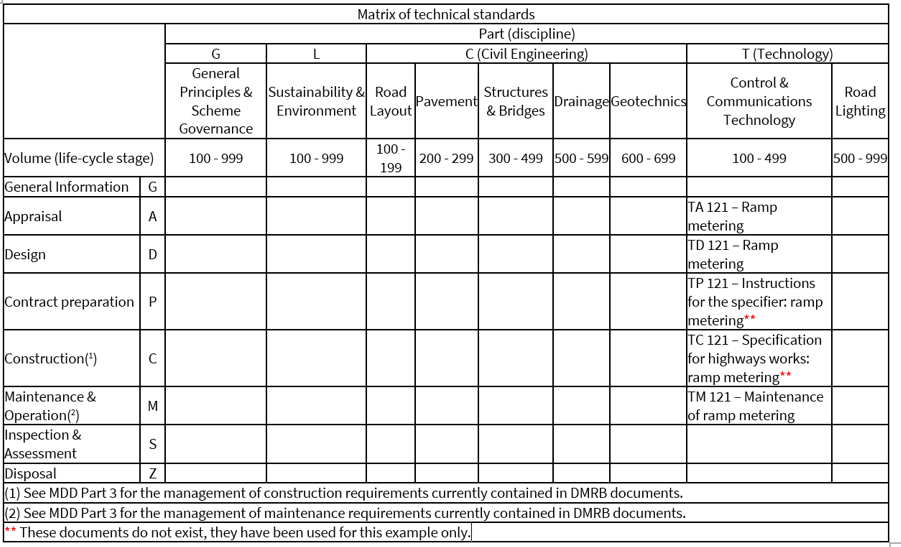
Using the proposed numbering system any ramp metering document would be T(x) 121 (where (x) defines the lifecycle stage). There may be subjects where it is not possible to follow the lifecycle through the matrix; contact TSG for help with any document numbering issues.
Back to topIn putting all the design and construction standards into the same set, will this discombobulate our suppliers?
We are communicating the changes to colleagues and the supply chain; the frequency of these communications will increase over the MCHW programme to coincide with the publication date. The supply chain are experienced and competent professionals.
The matrix for technical standards (FAQ 10.4) provides consistency when creating document unique identifier codes. With all documents about a subject having the same discipline letter and potentially number, the supply chain will become familiar with ‘T(x) 121’ referring to ramp metering. As the (x) changes dependant on lifecycle stage, the supply chain will know that ‘TD 121’ refers to ramp metering design and ‘TC 121’ refers to the construction specification for ramp metering. In doing so, this provides clarity on the flow of information from design into construction.
The wording used for sets of technical standards, such as the DMRB and MCHW, is currently under review by TSG. This is to ensure the documents which are included in those sets of technical standards are distinct and identifiable from a contractual point of view.
Back to topAre the MCHW documents set up under the current series numbers, which will be changes to the new numbers later?
Yes, the MCHW documents are set up under the current series title split by Volume 1 and Volume 2 (FAQ 10.4) for document numbering.
In the CARS reference manager there are some additional references for those Series’ that we know will be split during the review (e.g. Series 1200 Permanent markings, TTM and Loops).
Back to topThere were a few pilot documents used as part of the DMRB update, CD 236 for one, is there a pilot MCHW series planned to ensure transition/publication goes as expected?
[amended 30.10.23] The pilot that was undertaken in RIS1 on DMRB documents aimed at refining the drafting rules and assess the best way to engage content specialists. A similar pilot was undertaken to refine the MCHW rules back in 2019. No specific pilot was done on the publication.
The publication of the MCHW is slightly more complex than the DMRB due to the interconnected nature of the documents and therefore a subset of documents cannot be published in advance of the full publication. A validation task is proposed to be undertaken in advance of publication to inform training material and industry support
MCHW is used by local authorities as well as NH suppliers – what plans have you got to engage meaningfully with them about the MCHW update?
[29.3.22] The situation is the same as with DMRB. The Government only wants NH to produce MCHW for the OOs of the Motorway and All Purpose Trunk Roads – that is in the Technical Regulations Protocol attached to the NH Licence. We will be speaking to ADEPT, CSS Wales and SCOTS about the changes but we cannot include local road specific content under the Protocol.
Back to topCan we see what the end product (i.e. published MCHW documents) will look like, even a mock-up?
[amended 30.10.23] An overview of the publication outputs was shared during the DMRB/MCHW update webinar in July 2023. See slides here: https://help.futuredmrb.co.uk/update-webinars/#DMRB_and_MCHW_webinar_-_19th_July_2023
Back to topHow will the MCHW/DMRB big bang publication work and will there be a gap where content goes out of the MCHW and into the DMRB?
[amended 30.10.23] Where there is content that is identified as needing to come out of the MCHW into the DMRB, please use the standards governance process to publish an incremental change to the CARS document via Jira. If you have started an update to the DMRB that needs to be put on hold in favour of the more urgent consequential update from the MCHW, please consider using the revert version functionality.
Once the new style MCHW is published, the current MCHW will not disappear. It will be available on the standards for highways website (in a similar way to the DMRB) in the archive before the new MCHW is published. The contracted version will be a dated version of the Specification as defined by the contract.
Please contact TSG for any further guidance.
Can you share your stakeholder list so we can check and suggest any omitted?
This list can be provided on request, please email standards_enquiries@nationalhighways.co.uk
Back to topBrexit
Are there plans to deal with potential Brexit risks and perhaps more immediate changes?
Brexit is a complex area. Work is currently undertaken in TSG to manage risks associated with it. More information will be provided at the training for authoring. Brexit does not affect Document Development Plan development. If you have any queries with regards to CE marking or harmonised standards, please contact TSG Standards_Enquiries@nationalhighways.co.uk.
Back to topWill standard text / guidance be provided to cover Northern Ireland still effectively being in the European Union? Aspects such as CE marking or the UKNI/UKCA mark.
[amended 30.10.23] Yes TSG is supporting Northern Ireland with the new series 100, specifically Clause 104 which covers CE marking.
Back to topDepartures Approval System
Will the Departures Approval System (DAS) have to be revamped to suit the new document references?
DAS is updated each month with new documents as they are published. On publication of the new MCHW documents, DAS will be updated to include the new MCHW documents so they can be departed against as required.
DAS will be enhanced so that reporting on current and superseded documents can be undertaken together. As with the launch of the new DMRB, document mapping will be provided so that old series numbers are provided when searching for old departures.
Back to topCan the Departures Manual be made available via Standards for Highways?
[8.8.22] No. The Standards for Highways website will only list documents applicable to all of the four Overseeing Organisations and the Departures Manual is a National Highways only document. The Departures Manual can be downloaded here: https://das-help.highwaysengland.co.uk/
Back to top