
When developing requirements which refer to third party standards, the most important thing to consider is the performance characteristics of the object or thing you are specifying. What is the minimum viable level of performance required by the Overseeing Organisation? This performance can be anything from safety criterion to weather resistance to coating or treatment thicknesses.
Contents
Harmonised (Designated) Standards
If the third party standard being used is a Harmonised (Designated) Standard the performance characteristics being quoted in the requirement are critical to the minimum level of performance. Many Harmonised (Designated) Standards allow for a performance characteristic to be ANR – which means for performance characteristic A there is ‘No Requirement’. This allows the manufacturer to declare the performance of characteristic A as ‘No Requirement’ on the Declaration of Performance for the object in question. This is perfectly acceptable under the Harmonised (Designated) Standard. For this reason, requirements that state:
‘1.1… Object Z shall be in accordance with BS EN 123’,
may not be sufficient for the Overseeing Organisation’s minimum viable level of performance. As requirement 1.1 allows Object Z to have performance characteristics with ‘No Requirement’ and still be contractually compliant. There may be certain performance characteristics where the Overseeing Organisation is not particularly bothered by the level of performance and these may be declared as ‘No Requirement’. However, this does not justify a requirement like 1.1, it would be better to define that performance characteristic, say B, as BNR; it is unambiguous.
Example in plain English
2.1 Object Z shall be compliant with BS EN 123.
2.2 The Object Z shall meet the following performance characteristics: green in colour, steel grade S235JR [etc.].
2.3 The requirements of GC101 shall apply to Object Z.
The above example uses the same phraseology as the Standard Format Requirements (SFR) in CARS. Requirement 2.3, which is automatically added as part of the SFR, links the obligations of requirements 2.1 and 2.2 to the overarching obligations for Standards Equivalence, Designated Standards, and Product Certification Schemes in GC 101 (originally Series 100 Clause 104 and 105).
Back to topMore detailed example
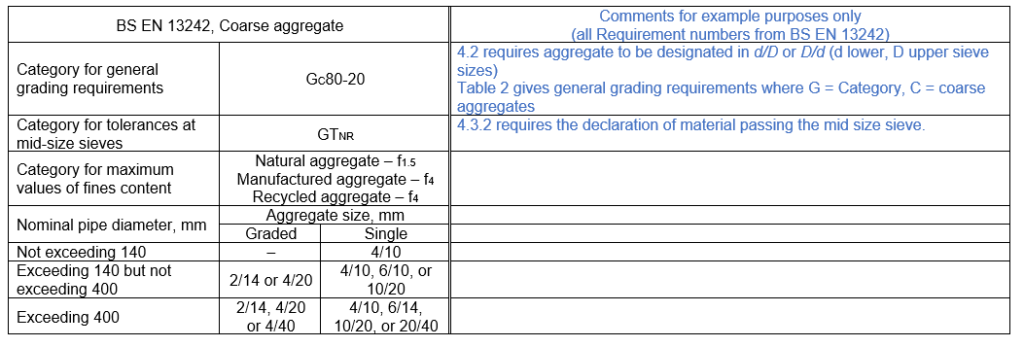
3.1 Coarse aggregate for pipe bedding, haunching, and surrounding shall be compliant with BS EN 13242.
3.2 The coarse aggregate used for pipe bedding, haunching, and surrounding shall meet the performance characteristics as stated in table 3.3 performance characteristics of coarse aggregate for pipe bedding, haunching, and surrounding material.
3.3 The requirements of GC 101 shall apply to coarse aggregate for pipe bedding, haunching, and surrounding material.
Annex ZA
Back to top